

Scuba Forge is reader-supported: some links on this page are affiliate links, and as an Amazon Associate Scuba Forge earns from qualifying purchases at no extra cost to you. Learn more.
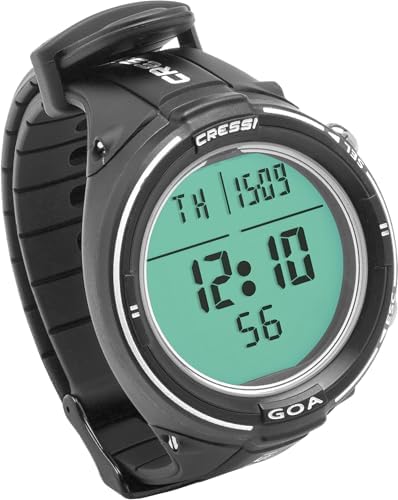
Cressi Goa
The Cressi Goa resists pressure up to 393 ft, so it suits you if you need a durable underwater computer.
48 mm case diameter
- Case Diameter
- 48 mm
Suits recreational scuba divers
- Recreational scuba divers
- Budget-conscious dive students
- Free diving hobbyists
- Snorkelers
$240 under the category median
- This Scuba Diving Computer
- $249.95
- Median of the 15 Scuba Diving Computers we screened
- $489.99
- Range
- $224 to $1549
- Cheaper than this one
- 1 of those 15
3.9/5 from 300 buyers
- Average buyer rating
- 3.9 out of 5
- Ratings behind it
- 300
- What that supports
- A large enough sample to read as a real buyer signal
- Where it comes from
- The product listing, read 10 November 2026
What the Cressi Goa Is, and Who For
Cressi Goa performs underwater calculations for scuba diving with a 1 3/8 in (35 mm) display for divers who need a compact unit with multiple dive programs.
Tracking your desaturation with an RGBM Algorithm allows you to manage your bottom time and ascent more accurately during a dive. The Cressi Goa uses this algorithm alongside a switchable Nitrox and Air mode to provide the data needed for repeated, multiday decompression dives.
This model provides a 393 ft (120 m) underwater resistance and a 1 3/8 in (35 mm) display, ensuring the information remains legible and the hardware remains protected. It also includes an ascent speed alarm and a PPO2 alarm to alert you to changes in your environment.
We evaluated 15 scuba diving computers and selected the Cressi Goa for this review because it was one of the most-rated products that passed screening, with 300 buyer ratings. Our methodology involves a data-driven spec breakdown of the products we evaluated to help you choose the right device. This review is for the first-time buyer looking for a versatile, compact underwater computer.
How Scuba Forge picked: we started from the 200 most-reviewed scuba diving computer listings in our retail dataset, removed duplicates, accessories and off-category products, and 15 qualified. This product is one of 15 from that pool chosen for a full review. Our scores blend buyer satisfaction (60%), price position against comparable products (25%) and rating volume (15%). Specifications come from manufacturer listings and ratings from verified Amazon buyer reviews (data checked November 2026).
The Short Answer on the Cressi Goa
Best for: you need a dedicated scuba diving computer that includes specialized programs for both recreational and free diving.
The Cressi Goa is a capable choice at the $249.95 price point.
- Pro: Includes a free diving program with customizable alarms.
- Pro: Features a 1 3/8 in (35 mm) high contrast display with mineral glass.
- Pro: Supports the RGBM algorithm (a method for calculating no-decompression limits) and Nitrox diving.
- Con: A 3.9 rating from 300 buyers indicates mixed user experiences compared to higher-rated alternatives.
Don’t buy this if: you require a housing diameter larger than 1 7/8 in (48 mm) for better visibility or a larger interface.
Price assessment: The $249.95 price is fair for a unit offering multiple dive programs and a mineral glass monitor.
Scuba Forge score: 8.1/10 (data-driven – see “How we picked” above)
New divers should view the best scuba diving computer for beginners to find a user-friendly interface.
The Numbers on the Spec Sheet
| Case Diameter | 48 mm |
| Display size | 35 mm |
| Underwater resistance | up to 393 ft (120 m) |
| Item weight | 0.03 Kilograms |
| Item dimensions | 4.02 x 4.02 x 4.02 inches |
| Display type | High contrast display, Mineral glass monitor |
| Buttons | 2 buttons |
| Programs | Scuba diving, Free diving, Air dive, Nitrox dive |
Case Diameter measures the width across the outer housing, which for the Cressi Goa is 48 mm.
Where this sits in the buyer data: Among the 15 products screened for this category, this one’s 3.9 rating places it #14, on 300 ratings – above the 186-rating median of that group, so the average rests on more feedback than most of its comparables. On price it undercuts 11 of them.
Understanding the hardware is vital, so learn how a scuba diving computer works before making a purchase.
Practical performance features of this Scuba Diving Computer
High Contrast Mineral Glass Display
The Cressi Goa features a 1 3/8 in (35 mm) high contrast display protected by mineral glass. A high contrast display provides clear visibility of data against the surrounding water, while mineral glass provides a harder surface than standard plastic to resist scratches during use. You can read the 393 ft (120 m) depth limit or your ascent speed alarms clearly even in varying light conditions.
The 35 mm screen size provides enough surface area for the RGBM algorithm (Reduced Gradient Bubble Model, a method used to calculate decompression limits) and Nitrox dive programs without overcrowding the interface. Because the display is housed in a 1 7/8 in (48 mm) case, the screen occupies a significant portion of the face, making it easier to check your PPO2 alarm or desaturation data at a glance.
Multi-Mode Diving Programs
You can switch between Nitrox and Air during desaturation because the Cressi Goa includes a dedicated Nitrox dive program and switchable gas settings. This allows you to adjust your gas mix mid-dive without manual recalculations to ensure your decompression limits remain accurate. The device also includes a free diving program with customizable alarms and an off mode for snorkeling, allowing you to toggle the software to match your specific activity.
The computer performs data acquisition every 5 seconds during scuba diving and every 2 seconds while free diving to ensure your depth and time logs are current. For multi-day decompression dives, the software supports repeated dives by tracking your cumulative exposure. You can rely on the ascent speed and decompression alarms to provide constant feedback as you manage your profile.
Heavy Duty Steel Construction
The Cressi Goa features a heavy duty case with steel buttons and a weight of 0.03 Kilograms. Steel buttons provide a tactile, durable interface that resists wear from salt water and repeated presses. The compact 4.02 x 4.02 x 4.02 inch dimensions ensure the unit remains manageable while providing a robust housing for the internal electronics.
The 393 ft (120 m) underwater resistance rating defines the maximum depth at which the device can safely function. Because the buttons are made of steel rather than plastic, they maintain their physical integrity over long-term use. You can secure the device to your wrist knowing the construction is designed to withstand the pressures and environment of repeated dives.
For a high-resolution display, view the Teric Color spec breakdown to see its performance features.
Where the Cressi Goa Sits Among the Alternatives
The Cressi Goa offers a versatile suite of dive programs, including a free diving program with customizable alarms and a dedicated air dive program for standard use. Its ability to switch between Nitrox and Air during desaturation makes it suitable for repeated, multiday decompression dives.
- The SEAC Driver Wrist-Mount Freediving Computer matches the Cressi Goa at the $249.95 price point.
- The SEAC Partner Wrist-Mount Freediving Computer also matches the Cressi Goa at the $249.95 price point.
- The Cressi Donatello Scuba Dive Computer is $25.95 cheaper than the Cressi Goa.
- The Mares Puck Pro+ 414135-GRBK is $69.05 more expensive than the Cressi Goa.
- The Suunto Ocean Dive Computer SS050984000 is $149.05 more expensive than the Cressi Goa.
If you require a more compact form factor for a streamlined profile, the Mares Puck Pro+ 414135-GRBK is the better pick despite the higher cost.
You can find our detailed Cressi Donatello analysis to see how it handles complex dive profiles.
If you need a reliable entry-level option, see our full Puck Pro+ review for more details.
What It Takes to Run This Scuba Diving Computer
Setting up your Cressi Goa
You must have a compatible charging cable to power the Cressi Goa before you can begin using the device.
- Unpack the Cressi Goa and verify the 4.02 x 4.02 x 4.02 inch dimensions match the package contents.
- Connect the charging cable to the unit to replenish the internal power source.
- Select either the Scuba diving program or the Free diving program depending on your intended use.
- Configure the customizable alarms for the free diving program to your specific depth limits.
Warranty and support: what to check
Warranty coverage and support terms differ by seller and country.
- Confirm the mineral glass monitor is free of surface scratches, as the glass is a primary interface for depth readings.
- Verify the steel buttons click fully into place to ensure the interface remains functional under pressure.
- Check that the 48 mm case diameter and 35 mm display size match the physical unit to confirm you received the correct model.
Test the device by powering it on and cycling through the Nitrox and Air dive programs the day it arrives to ensure the software functions before the return window closes.
Questions Buyers Ask About This Underwater Computer
Scuba Diving Computer Value and Versatility
This algorithm allows the device to support repeated, multiday decompression dives by tracking gas loading over several sessions. This capability means you can plan complex trips without needing a more expensive unit just to manage basic decompression safety.
For those who also train in freediving, the Cressi Goa includes a free diving program with customizable alarms. This allows you to use one device for two different activities, which is useful if you do not want to carry a separate freediving computer. The device captures data every 2 seconds while free diving, providing a frequent enough update for training purposes. Because it covers both scuba and freediving, it serves as a versatile tool for multi-sport underwater athletes.
The Cressi Goa offers a high level of functionality for its price, such as the Nitrox dive program and switchable modes between Nitrox and Air during desaturation. These features ensure that the device handles the core requirements of recreational and technical diving without the cost of a flagship model. Think of it like a reliable sedan: it provides all the necessary safety and transport features you need for daily travel without the extra costs of a luxury sports car.
Is the Cressi Goa a good deal compared to more expensive computers?
The Cressi Goa provides a balance of essential features like the RGBM algorithm and multiday decompression support for a $249.95 price. While more expensive computers may offer larger displays or more complex gas mixing, the Cressi Goa provides the core data needed for safe diving at a lower entry point.
Does the Cressi Goa handle multi-day decompression dives reliably?
Yes, the Cressi Goa handles multiday decompression dives because it features an RGBM algorithm and a Nitrox dive program. These features allow the computer to track and manage your nitrogen levels over successive dives, which is a requirement for multi-day trip planning.
Is the free diving mode useful for training?
The free diving mode is useful for training because it includes customizable alarms and captures data every 2 seconds. This allows you to track your depth and time during practice sessions without needing a dedicated freediving computer.
If you are confused by technical data, review our scuba diving computer specs explained in plain language.
Is the Cressi Goa Right for You?
Who the Cressi Goa suits and the jobs it is the wrong choice for, listed below with the reason for each.
Who this scuba diving computer is for, and what it does well
Who the Cressi Goa suits
- Recreational scuba divers — the 120 m depth rating and RGBM algorithm provide reliable safety for standard recreational limits
- Budget-conscious dive students — the $249.95 price point makes it an accessible entry-level computer with a heavy-duty case
- Free diving hobbyists — the dedicated free diving program with customizable alarms allows for specific depth tracking
- Snorkelers — the off mode allows the device to be used for surface swimming without draining the battery on unnecessary data
- Nitrox divers — the switchable Nitrox and Air program during desaturation allows for safe gas switching during multi-day trips
What this underwater computer handles well
- Multi-day decompression diving — suitable for repeated dives due to the RGBM algorithm and Nitrox switching
- Free diving — the free diving program with 2-second data acquisition intervals
- Nitrox diving — the dedicated Nitrox dive program and switchable gas settings
- Underwater photography — the 120 m depth rating and mineral glass monitor provide durability for deep water use
- Surface swimming — the off mode for snorkeling or swimming
What this subsurface computer is the wrong choice for
- Technical diving beyond 120m — the underwater resistance is limited to 393 ft
- Complex multi-gas management — the 2-button interface limits quick navigation compared to multi-button units
- High-precision surface navigation — the 35 mm display size is small for viewing complex maps or large data sets
- Professional cave diving — the 2-button layout may be too simple for complex decompression profiles
What to budget alongside this scuba diving computer, and what to skip
Accessories worth buying with the Cressi Goa
- Dive computer mount — needed to secure the 48 mm case to a mask strap or BCD
- Replacement batteries — required to maintain the larger battery capacity over long-term use
- Dive computer strap — necessary to attach the 0.03 kg device to the wrist
- Dive watch — to provide a secondary time reference since the device focuses on diving programs
- Dive accessories kit — needed to protect the mineral glass monitor during transport
Accessories you can skip buying for this scuba diving computer
- External GPS module — not supported by the current 2-button and basic scuba diving program
- Separate free diving computer — the included free diving program with customizable alarms covers this need
- Nitrox gas switcher — the switchable Nitrox and Air program is built into the software
Where to Buy This Scuba Diving Computer
When we looked in November 2026, the Cressi Goa was listed at $249.95 – a snapshot that may have changed since.
Scuba diving computers are sold by the retailers below – we do not track which of them has the Cressi Goa in stock, so check availability and the current price with the retailer before making a trip.
- DiveInn (online only) — large online catalog for international and domestic brands
- Dick’s Sporting Goods (online and physical stores) — wide availability of mainstream brands and physical locations
- REI (online and physical stores) — reliable inventory of major brands and in-store expert advice
- Amazon (online only) — massive selection and easy comparison of consumer models
- ScubaGear (online only) — specialist retailer with deep technical inventory
- Triton Sports (online and physical stores) — specialist retailer with expert staff and technical gear
Final Verdict on the Cressi Goa
If you need a versatile scuba diving computer that handles multiple dive types, the Cressi Goa is a capable option at around $249.95. This underwater computer features a high contrast display and a mineral glass monitor to ensure visibility in various lighting conditions. The 48 mm case diameter provides a compact form factor for the wrist.
The Cressi Goa includes a free diving program with customizable alarms, a specific mode for snorkeling or swimming, and a dedicated scuba diving program. It supports the RGBM algorithm—a method for calculating remaining no-decompression limits—and allows users to switch between Nitrox and Air during desaturation. These features make it suitable for repeated, multiday decompression dives. The device captures data every 5 seconds while scuba diving and every 2 seconds while free diving.
The 3.9 rating from 300 buyer ratings provides a significant signal of real-world owner experience. The unit is built with a heavy duty case and steel buttons, providing a physical interface designed for underwater use. It offers underwater resistance up to 393 ft (120 m), which defines the deepest point the device can safely function.
You should choose the Cressi Goa if you require a multi-mode device that supports both scuba and free diving with specific gas switching capabilities. It is available for around $249.95.
The 3.9 average across 300 ratings serves as a primary indicator of how this model performs in the hands of other divers. It offers a balanced set of programs for varied underwater needs.
Skip it if: You require a larger display than the 35 mm size provided or need a device with more than 2 buttons for navigation.
The rest of our subsurface computer guides
- Which Scuba Diving Computer with GPS Is Best?
- Best Dive Computers for Nitrox
- Tracking Depth and Bottom Time While Snorkeling With a Scuba Diving Computer
- Which Scuba Diving Computer Keeps You Safe During Deep Technical Dives Under 260m?
- The Scuba Diving Computers That See My Dive Data on My Phone
- The Scuba Diving Computers That Work Best for Beginners